The desktop operating system is the ultimate harness.
Models. Memory. Context. Apps. Silicon. The operating system is the only layer that can make them one.
One intelligence layer across work, creation, and play. Local by default, frontier when it matters, yours all the time.
“Anthropic defines its individual customers as ‘prosumers’: people who subscribe to AI tools to do knowledge work... executing multi-step workflows on a user’s desktop.”
Anthropic · Form S-1 · October 26, 2026
The Operating System for Intelligence
1
Press release · For immediate release November 10, 2026, 6:00 a.m. PT
The Team That Shipped Cyanogen, Android and Playtron Unveils KORA: A New Desktop OS for the Age of Intelligence, Open to Every Model and Agent
Built on Linux from the kernel up, KORA gives local models, frontier models and agentic services the system-level integration closed platforms cannot offer, and opens the entire operating system to every model, AI service and agent.
PALO ALTO, Calif., Nov. 10, 2026
KORA Systems Inc. today unveiled KORA, The Operating System for Intelligence: a new desktop operating system, built on Linux, in which models and agents are part of the OS itself. KORA is a pure-play company building a truly native desktop operating system for intelligence, and it comes from a team that has already shipped three operating systems, Cyanogen, Android and GameOS, to more than a billion devices.
Every desktop operating system in use today was finished before intelligence arrived. On macOS and Windows, AI lives in a browser tab or an app sandbox. It cannot see the machine it runs on, schedule the silicon beneath it, or reach the files, memory and applications around it. Both platforms are closed, so that is where the integration ends. Linux is the only operating system that can be completely transformed by intelligence. KORA is that transformation.
KORA is built from the kernel to the shell around one idea: intelligence belongs inside the operating system. KORA's Cortex is the nervous system of the OS, a hybrid inference engine optimized for local models that turns every chip in the machine, CPU, GPU and NPU, and every machine on the network into one computer. Local models run on the user's own silicon by default, and frontier models join when the work calls for them. Neural workspaces and file systems replace the folders-and-apps desktop with one organized around intent, context and memory. Each workspace is a secure sandbox for its applications and agents, with permissions the user manages, and memory and context stay on the user’s own computer. The KORA SDK lets third parties integrate with KORA’s primitives, including projects, memory, context, semantic search and email.
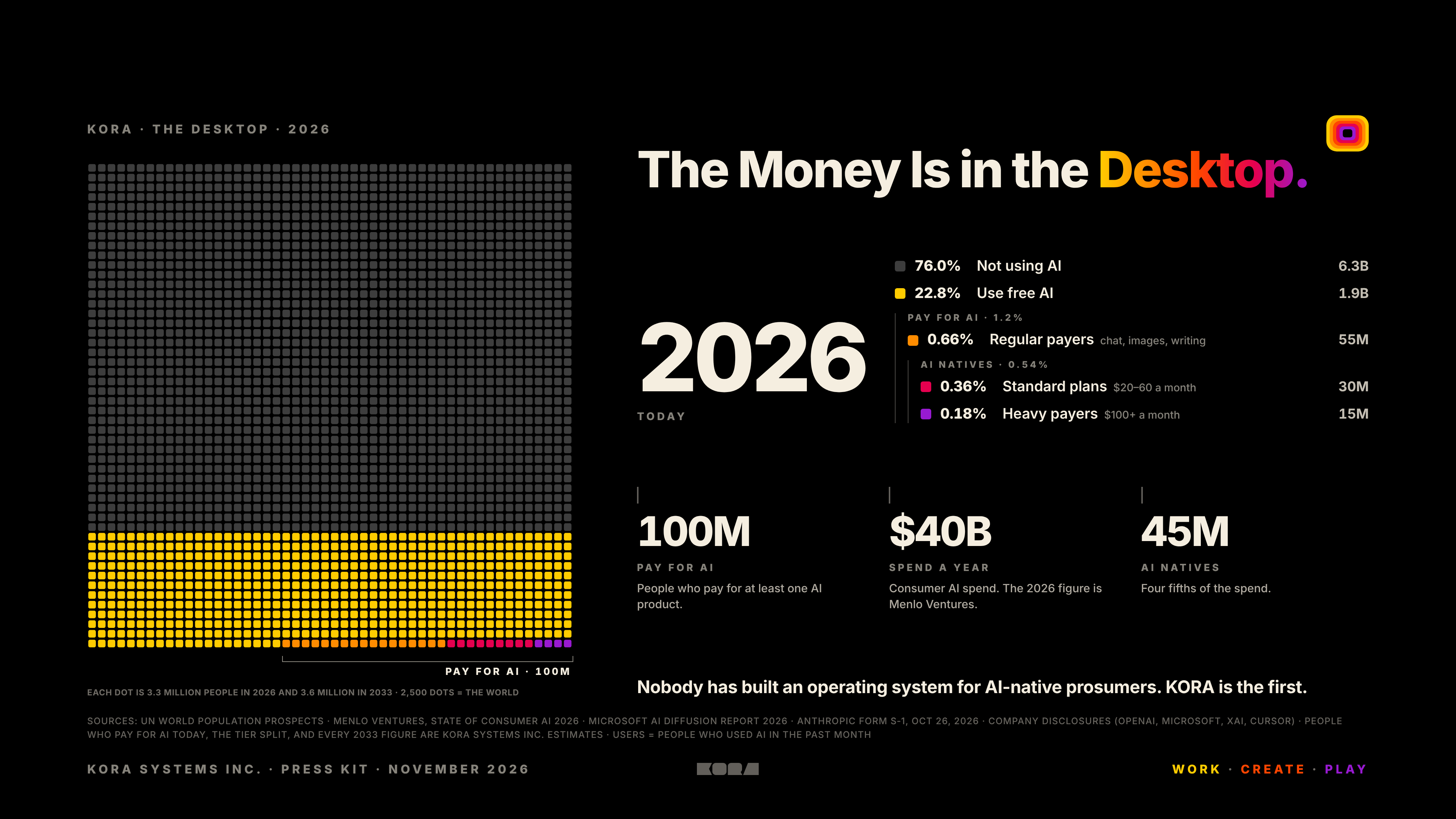
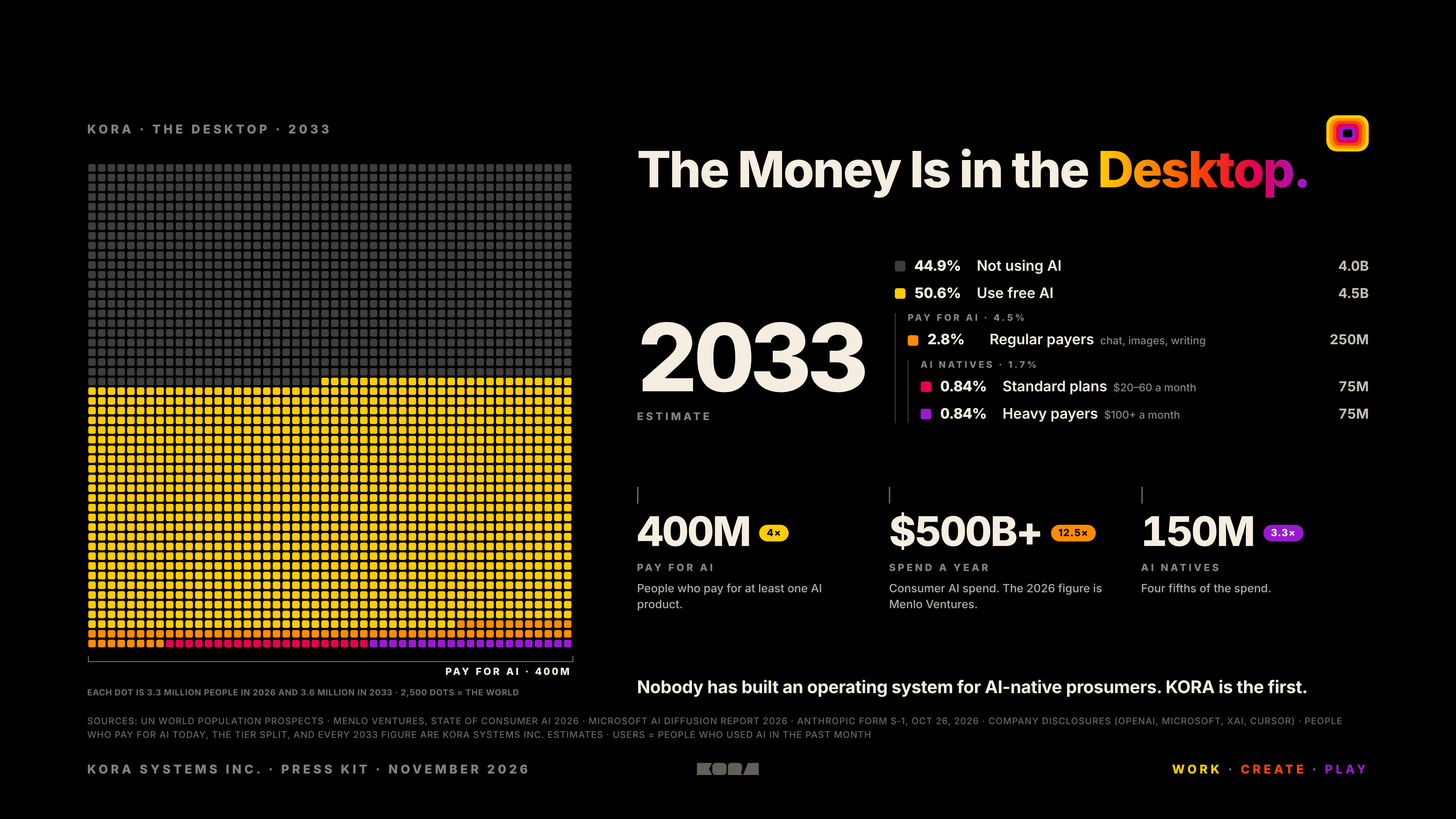
“The desktop operating system is the ultimate harness. Roughly 100 million people pay for AI today, about one percent of the world. Four fifths of the money comes from 45 million of them, the AI-native prosumers who run agents and coding tools all day, and almost all of that work happens on a desktop running an operating system built 40 years ago. By 2033 that is 400 million people paying, 150 million AI natives among them, and half a trillion dollars a year. The AI native is KORA’s market. The rest is upside. Nobody has built an operating system for them. KORA is the first.”
Kirt McMaster, Chief Executive Officer of KORA Systems Inc
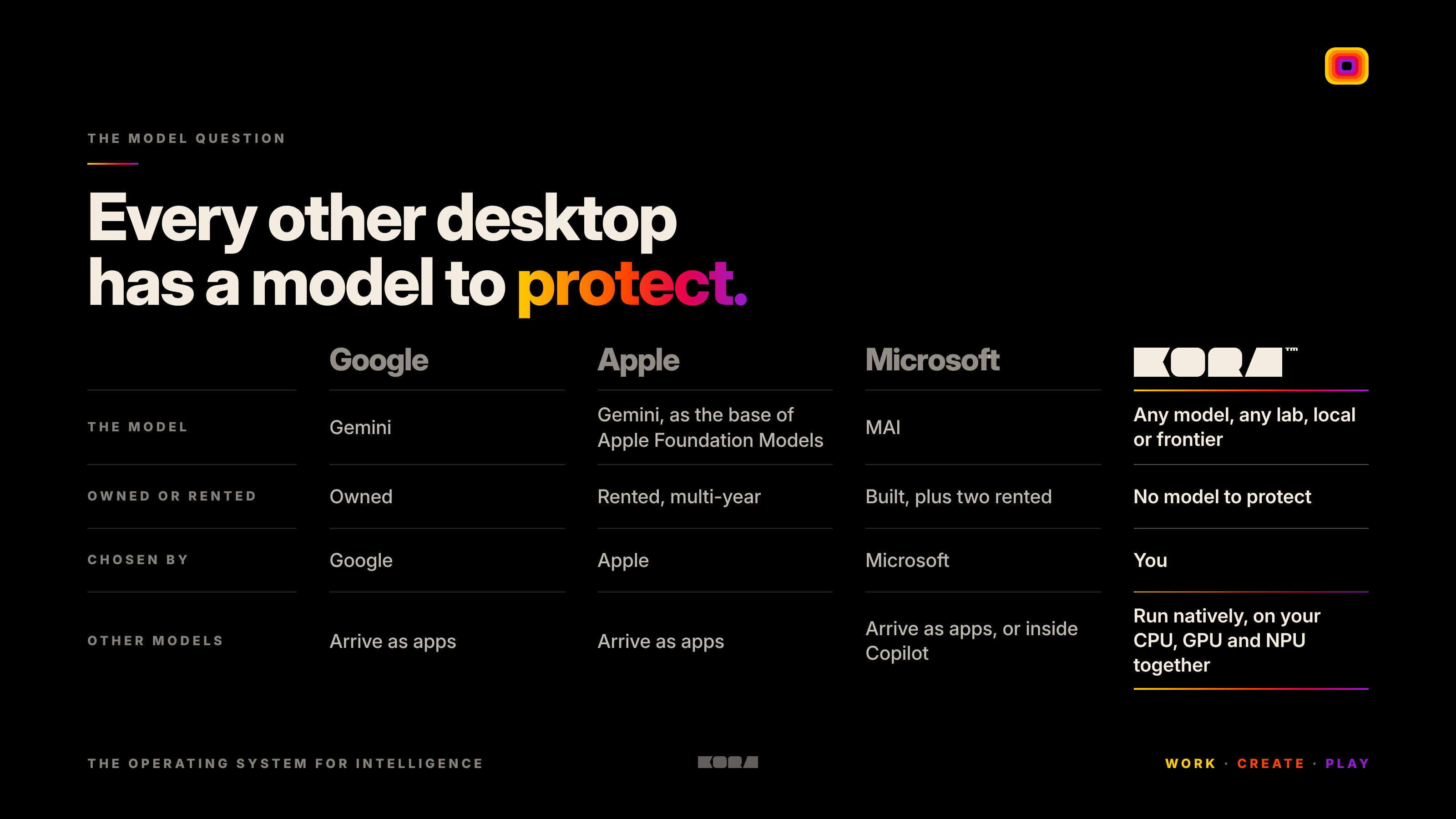
Openness is the point. KORA's goal is an open intelligence ecosystem: an operating system open to every model, every AI service and every agent, where partners integrate at the system level. The capabilities behind KORA’s own applications, including memory, neural workspaces and file systems, will be available to third-party developers under the same user-managed permissions. A local model can become the default mind of the machine. An agentic service can run as part of the OS, with the identity, memory, permissions and compute the OS provides. That has been KORA's thesis from the first day of the project, and it is the one thing no incumbent can copy. Their platforms are closed by design, and their intelligence answers to their business models. KORA answers to the person at the keyboard.
KORA grew out of Playtron, the company McMaster founded to break Windows' hold on the gaming PC. Playtron built GameOS, a complete Linux operating system from the kernel to the compositor, and shipped it on devices in record time on a record budget. That work produced the one thing every intelligent operating system needs and no application can supply: a full OS the team controls end to end. KORA has been in development on that foundation since November 2025, built by the same engineers who shipped GameOS. GameOS lives on inside KORA as GameFrame, its play mode: one click turns a KORA desktop into a game console running the PC catalog. Work, Create and Play, on one machine.
“I joined Android when it had a hundred thousand users and left when it had a billion. It got there because it was open to everyone who wanted to build on it. Intelligence is the next platform shift, and it needs the same thing: an operating system where every model, every service and every agent is a first-class citizen. KORA opens that door on day one. The ecosystem that walks through it will decide the next decade of computing.”
John Lagerling, Chief Business Officer of KORA Systems Inc
KORA is built first for developers and creators: the people who already pay for intelligence, run models on their own silicon and buy the hardware to do it. KORA’s own applications connect communication, organization and creation in one environment, so people move between ideas, tools and agents without rebuilding context. On KORA, a single workflow can span a local model, a frontier model and a dozen agentic services, scheduled across the whole machine, with the results landing in a workspace that remembers.
KORA is coming to PCs in 2027, including Snapdragon-powered machines through KORA's collaboration with Qualcomm Technologies. HUMAIN OS, the enterprise operating system KORA is co-developing with HUMAIN, was announced separately and is planned for 2027. Updates and the full story are at kora.fun.
The desktop
The Money Is in the Desktop.
Who pays for AI, 2026 and 2033 (people)
Group
2026
2033 (estimate)
Not using AI
6.3B
4.0B
Use free AI
1.9B
4.5B
Pay for AI
55M
250M
AI natives, standard plans
30M
75M
Heavy payers
15M
75M
Spend a year
$40B
$500B+
Pay for AI · 400M
Each dot is 3.3 million people in 2026 and 3.6 million in 2033 · 2,500 dots = the world
2033
TodayEstimate
44.9%Not using AI4.0B
50.6%Use free AI4.5B
Pay for AI · 4.5%
2.8%Regular payerschat, images, writing250M
AI natives · 1.7%
0.84%Standard plans$20–60 a month75M
0.84%Heavy payers$100+ a month75M
400M4×
Pay for AI
People who pay for at least one AI product.
$500B+12.5×
Spend a year
Consumer AI spend. The 2026 figure is Menlo Ventures.
150M3.3×
AI natives
Four fifths of the spend.
Sources: UN World Population Prospects · Menlo Ventures, State of Consumer AI 2026 · Microsoft AI Diffusion Report 2026 · Anthropic Form S-1, Oct 26, 2026 · Company disclosures (OpenAI, Microsoft, xAI, Cursor) · People who pay for AI today, the tier split, and every 2033 figure are KORA Systems Inc. estimates · Users = people who used AI in the past month
KORA Systems Inc. is building the operating system for intelligence: KORA, a ground-up reimagining of the desktop for the age of intelligent PCs. KORA's Cortex is the nervous system of the OS, a hybrid inference engine optimized for local models that turns every chip in the machine and every machine on the network into one computer, and neural workspaces and file systems are its new user experience. The team has deep roots in operating-system engineering and platform-ecosystem building, with three operating systems, Cyanogen, Android and GameOS, shipped to more than a billion devices. KORA Systems Inc. is backed by Samsung, Square Enix, Polychain, VanEck, Circle and Alumni Ventures. For further details about KORA, please visit kora.fun.
KORA Advances Linux-Based Operating Systems for Intelligence on Snapdragon
Close to a year of engineering brings a full Linux desktop, system on a chip inference and large AI models on-device to Snapdragon X2 Elite; HUMAIN OS for the enterprise and KORA, The Operating System for Intelligence for developers and creators, arrive on PCs powered by Snapdragon in 2027
PALO ALTO and SAN DIEGO, Calif., Nov. 10, 2026
KORA Systems Inc. is working with Qualcomm Technologies, Inc. to advance Linux-based operating systems for intelligence on PCs with Snapdragon® X Series platforms. Close to a year of engineering by the two companies has brought a complete Linux desktop operating system to PCs with Snapdragon X2 Elite, with large AI models running entirely on the device and inference scheduled across the platform's CPU, GPU and NPU.
The work is the foundation for two operating systems arriving on PCs powered by Snapdragon in 2027: HUMAIN OS, the enterprise-grade, AI-native operating system KORA is developing with HUMAIN first unveiled at LEAP 2026 in Riyadh; and KORA, The Operating System for Intelligence, a new desktop operating system built for developers and creators.
Operating systems in use today were designed before computers could run intelligence of their own. KORA takes a fundamentally new approach, building on Linux as an open foundation engineered around intelligence from the kernel up, and Snapdragon X2 Elite supplies the silicon: the Qualcomm Oryon™ CPU, Qualcomm® Adreno™ GPU and an 80 TOPS Qualcomm® Hexagon™ NPU on one platform, with the efficiency to run large models on a laptop.
Engineers from Qualcomm Technologies worked alongside KORA throughout, from bringing up the Linux desktop on Snapdragon X2 Elite to tuning inference across the CPU, GPU and NPU. Qualcomm Technologies continues to upstream Snapdragon X2 Elite support into the mainline Linux kernel, work that benefits both operating systems and the wider Linux ecosystem.
What KORA built for PCs with Snapdragon
A complete Linux desktop on Snapdragon X2 Elite. KORA's Linux platform runs on Snapdragon X2 Elite from the kernel up, including a new desktop environment designed and built by KORA for intelligent PCs. The first OEM PCs in the world to ship with a Linux desktop operating system on a PC with Snapdragon X2 Elite will run HUMAIN OS in 2027.
Inference across the whole processor. KORA's Cortex, the hybrid inference engine at the core of both operating systems, schedules AI workloads across the CPU, GPU and NPU of Snapdragon X2 Elite, so the entire chip works on the task at hand. Cortex extends the same scheduling to other machines on the local network.
Large models entirely on-device. The ability to run a 26-billion-parameter language model locally on PCs with Snapdragon X2 Elite, alongside automatic speech recognition and embedding models. Responses stay fast, dependence on the cloud goes down, and sensitive information can stay on the device.
Agents built into the operating system. Agents are part of the OS architecture and can work with authorized system capabilities, applications, files and services, so AI can complete real work across the desktop. A neural file system indexes files by meaning, so people and agents can find information by what it contains as well as by name or folder.
Windows software for Snapdragon. Compatibility and translation technologies developed by KORA run selected Windows x86-64 applications inside the Linux environment on Snapdragon, so people keep access to the software they rely on as they move to a new platform.
Two operating systems. One foundation.
HUMAIN OS is the enterprise-grade, AI-native operating system KORA is developing in collaboration with HUMAIN. It is organized around intent, intelligence and action: users express what they want to accomplish, and the operating system assembles the relevant context, selects the appropriate local or cloud intelligence, and coordinates agents and applications to complete the work. HUMAIN OS integrates enterprise email, calendars and chat to provide a unified view of workplace information, alongside a suite of AI-native office applications. First demonstrated at LEAP 2026, HUMAIN OS is expected to become commercially available in 2027.
KORA is The Operating System for Intelligence: a new desktop operating system built for developers and creators, and a ground-up reimagining of the desktop for the age of intelligent PCs. KORA shares the foundation developed with Qualcomm Technologies, including Cortex, neural workspaces and file systems, and it is open at the model layer: any model, from any lab, local or cloud, the user's choice. KORA comes to Snapdragon-powered PCs in 2027.
“Every operating system in use today was designed before the computer had a mind. For close to a year, we have been building what comes after it with Qualcomm Technologies, on Snapdragon platforms: a full Linux desktop, large models running on the device, and the CPU, GPU and NPU working on the task as one machine. HUMAIN OS is the first operating system to ship on that foundation. KORA, The Operating System for Intelligence, follows on Snapdragon in 2027, built for the developers and creators who want the whole computer working for them.”
Kirt McMaster, Chief Executive Officer of KORA Systems Inc
“Snapdragon X2 Elite was designed to run advanced AI on the device, across the CPU, GPU and NPU. KORA's work brings a complete Linux desktop operating system built around that capability to Snapdragon, and we look forward to HUMAIN OS and KORA arriving on PCs powered by Snapdragon in 2027”
“HUMAIN OS is redefining the enterprise computing experience by putting intelligence at the core of how people work. By bringing together enterprise applications, contextual intelligence and AI agents in one unified operating system, we are enabling people to move seamlessly from intent to action. Together with KORA and Qualcomm Technologies, we are bringing this next generation of AI-native computing to market, delivering powerful on-device intelligence, greater productivity and a fundamentally smarter way to work”
Tareq Amin, Chief Executive Officer, HUMAIN
Availability
HUMAIN OS will be commercially available in 2027, debuting on the world's first OEM PCs to combine a Linux-based desktop operating system with the Snapdragon X2 Elite platform. KORA will follow later in 2027, expanding availability to Snapdragon-powered PCs.
About KORA
KORA Systems Inc. is building KORA, The Operating System for Intelligence: a ground-up reimagining of the desktop for the age of intelligent PCs. At its core is Cortex, the nervous system of the OS, a hybrid inference engine optimized for local models that turns every chip in the machine and every machine on the network into one computer. Neural workspaces and file systems form the new user experience. The KORA team has deep roots in operating-system engineering and platform-ecosystem building, having shipped three operating systems, Cyanogen, Android and GameOS, to more than a billion devices. KORA's investors include Samsung, Square Enix, Polychain, VanEck, Circle and Alumni Ventures. For further details about KORA, please visit kora.fun.
Snapdragon and Qualcomm branded products are products of Qualcomm Technologies, Inc. and/or its subsidiaries. Qualcomm, Snapdragon, Hexagon and Adreno are trademarks or registered trademarks of Qualcomm Incorporated.
HUMAIN OS is the enterprise-grade, AI-native operating system KORA is developing in collaboration with HUMAIN, the PIF-backed AI company in Saudi Arabia. The partnership was announced at LEAP 2026 in Riyadh, where HUMAIN OS was demonstrated for the first time in an early form.
HUMAIN OS is built on KORA's Linux and agentic platform. It is organized around intent, intelligence and action: users express what they want to accomplish, and the operating system assembles the relevant context, selects the appropriate local or cloud intelligence, and coordinates agents and applications to complete the work. It integrates enterprise email, calendars and chat to provide a unified view of workplace information, alongside a suite of AI-native office applications.
HUMAIN OS is expected to become commercially available in 2027, debuting on the world's first OEM PCs to combine a Linux-based desktop operating system with the Snapdragon X2 Elite platform. HUMAIN has said it is targeting a 26-billion-parameter model running locally on the Qualcomm NPU.
HUMAIN OS and KORA are two operating systems on one foundation: the Linux desktop, Cortex, neural workspaces and file systems that KORA built with Qualcomm Technologies on Snapdragon. HUMAIN OS serves the enterprise. KORA, The Operating System for Intelligence, serves developers and creators, and comes to Snapdragon-powered PCs in 2027.
Joint release: "HUMAIN and KORA Partner to Build Operating System at LEAP 2026" (PR Newswire): https://www.prnewswire.com/news-releases/humain-and-kora-partner-to-build-operating-system-at-leap-2026-302865087.html
KORA Systems Inc., Palo Alto, Calif. The company was founded as Playtron in 2022 and built GameOS, a complete Linux operating system that shipped on devices. KORA has been in development on that foundation since November 2025.
Product
KORA, The Operating System for Intelligence: a new desktop operating system, built on Linux, in which models and agents are part of the OS itself.
Announced
November 10, 2026.
Who it is for
Built first for developers and creators: the people who already pay for intelligence, run models on their own silicon and buy the hardware to do it.
Three modes
Work, Create and Play, on one machine.
Cortex
The nervous system of the OS: a hybrid inference engine optimized for local models that turns every chip in the machine (CPU, GPU and NPU) and every machine on the network into one computer. Local models run on the user's own silicon by default; frontier models join when the work calls for them.
Neural workspaces and file systems
The new user experience. They replace the folders-and-apps desktop with one organized around intent, context and memory. The neural file system indexes files by meaning, so people and agents can find information by what it contains as well as by name or folder.
GameFrame
GameOS lives on inside KORA as GameFrame, its play mode: one click turns a KORA desktop into a game console running the PC catalog.
Openness
An operating system open to every model, every AI service and every agent, where partners integrate at the system level. Any model, from any lab, local or cloud, the user's choice.
Availability
KORA is coming to PCs in 2027, including Snapdragon-powered machines through KORA's collaboration with Qualcomm Technologies.
Qualcomm
Close to a year of engineering by the two companies has brought a complete Linux desktop operating system to PCs with Snapdragon X2 Elite, with large AI models running entirely on the device and inference scheduled across the platform's CPU, GPU and NPU. Qualcomm Technologies continues to upstream Snapdragon X2 Elite support into the mainline Linux kernel.
HUMAIN OS
The enterprise-grade, AI-native operating system KORA is developing in collaboration with HUMAIN, announced at LEAP 2026 in Riyadh and built on KORA's Linux and agentic platform. It is expected to be commercially available in 2027, debuting on the world's first OEM PCs to combine a Linux-based desktop operating system with the Snapdragon X2 Elite platform.
Team
Deep roots in operating-system engineering and platform-ecosystem building: three operating systems, Cyanogen, Android and GameOS, shipped to more than a billion devices.
Leadership
Kirt McMaster, Chief Executive Officer. John Lagerling, Chief Business Officer. Franck De Girolami, Chief Technology Officer.
Investors
Samsung, Square Enix, Polychain, VanEck, Circle and Alumni Ventures.
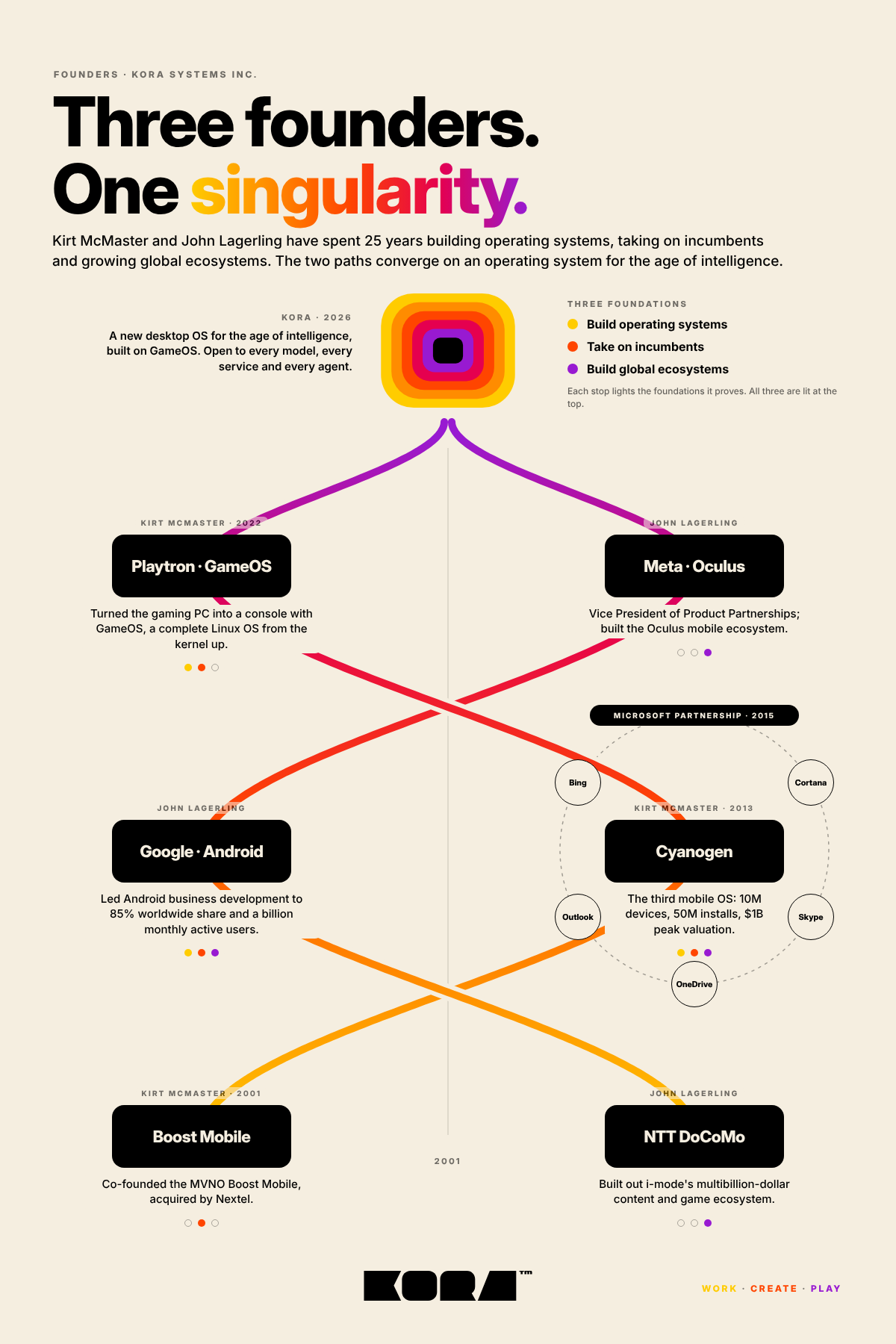
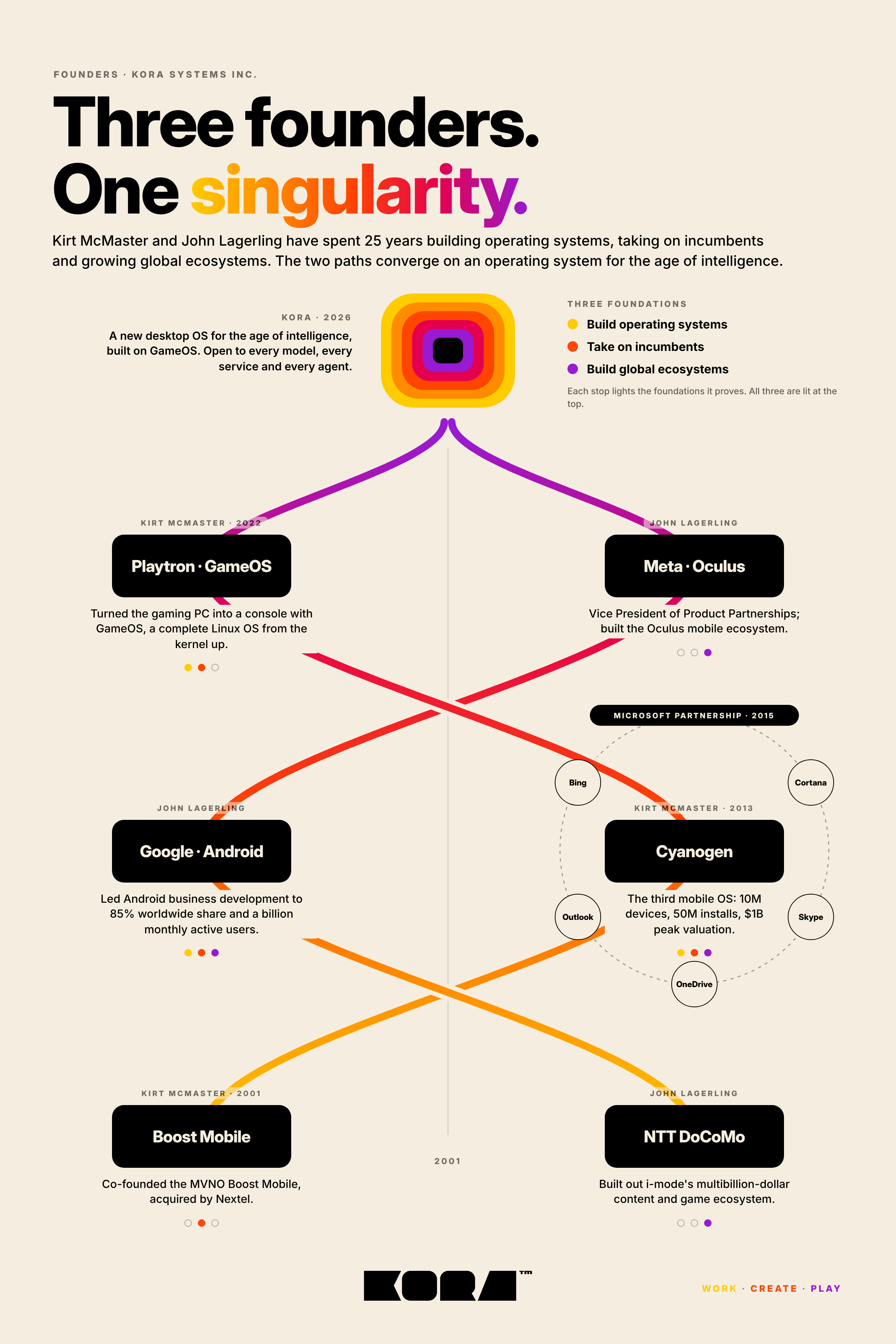
Kirt McMaster has spent his career going after the control layers of computing to hand power back to the user, starting with the carrier: he co-founded the MVNO Boost Mobile, acquired by Nextel. Next came the mobile OS: he co-founded Cyanogen to build the third mobile operating system shipping on ten million devices with more than fifty million installs, thousands of active contributors and at one point GitHub's second-largest repository. Microsoft built Cortana, Skype and other core services into it, and it reached a $1 billion peak valuation with top-tier strategic and venture backing. Next came the gaming PC: in 2022 he founded Playtron to turn it into a console and break Windows' hold on it, shipping GameOS, a complete Linux operating system from the kernel up. Now comes the desktop for the age of intelligence: KORA, built on GameOS. Few founders have shipped one operating system. He is on his third.
John Lagerling
Chief Business Officer
John Lagerling has been building the ecosystems around new computing platforms for more than twenty years. At NTT DoCoMo he built out i-mode's multibillion-dollar mobile content and game ecosystem. At Google he led Android business development, assembling the carriers, OEMs, chipmakers and content partners that took Android to 85 percent worldwide market share and a billion monthly active users, one of the largest operating-system ecosystems ever built. At Facebook, as Vice President of Product Partnerships, he built the Oculus mobile ecosystem. He later ran Mercari U.S., growing it tenfold through a $6 billion IPO, and two startups he co-founded, backed or led, AdMob and Cronologics, were sold to Google. Intelligence is the next shift. At KORA he is building the open ecosystem it needs: an operating system where every model, every service and every agent is a first-class citizen.
Franck De Girolami
Chief Technology Officer
Franck De Girolami is Chief Technology Officer of KORA Systems Inc., where he leads product and engineering. With 35 years of leadership, he created the survival-horror category with the Alone in the Dark series at Infogrames, pioneered real-time CGI on the SGI RealityEngine with titles like Cyberia, and co-founded and scaled Code Particle, a global software engineering firm whose clients include Activision (Call of Duty), EA (Battlefield 2042), CrowdStrike, Warner Bros., Ziff Davis, and Mediacom. He built and shipped GameOS end to end, a complete Linux operating system from the kernel to the compositor, with the team that now builds KORA's intelligence-native primitives, including Cortex, its hybrid inference engine.
KORA is a new desktop operating system, built on Linux, in which models and agents are part of the OS itself. KORA Systems Inc. calls it The Operating System for Intelligence. It is built first for developers and creators, and it comes to PCs in 2027, including Snapdragon-powered machines.
Why does the world need a new desktop operating system?
Every desktop operating system in use today was finished before intelligence arrived. On macOS and Windows, AI lives in a browser tab or an app sandbox. It cannot see the machine it runs on, schedule the silicon beneath it, or reach the files, memory and applications around it. Both platforms are closed, so that is where the integration ends. KORA is built from the kernel to the shell around one idea: intelligence belongs inside the operating system.
Linux is the only operating system that can be completely transformed by intelligence. macOS and Windows are closed. KORA takes a fundamentally new approach, building on Linux as an open foundation engineered around intelligence from the kernel up, with a full operating system the team controls end to end.
Is KORA an app, a layer on top of another OS, or a Linux distribution?
KORA is a full operating system, from the kernel to the shell. The team that builds it shipped GameOS, a complete Linux operating system from the kernel to the compositor, on devices. KORA is built on that foundation, with parts the folders-and-apps desktop never had: Cortex, its hybrid inference engine; neural workspaces, which keep applications, agents and project information for different parts of a person's life apart; the neural file system, which indexes files by meaning as well as by name or location; and an integrated application suite built for working with AI throughout the day. These are designed together, so permissions, memory and file history behave the same way across the whole system.
What is Cortex? Is it open source?
Cortex is the nervous system of the OS: a hybrid inference engine that turns every chip in the machine, CPU, GPU and NPU, and every machine on the network into one computer. It optimizes local models to make effective use of the computer's hardware, which reduces cloud token costs, and cloud models are available when the work calls for them. Local models power the analysis behind KORA's memory system, so the contacts, email, calendar events and files a person connects are analyzed on their own computer. KORA projects that about 70 percent of the model calls it manages will run locally in 2027, with the balance depending on the hardware and the workload. Cortex is KORA's own technology and is not open source. The ecosystem around it is open: any model, from any lab, local or cloud, the user's choice.
What does "open to every model and agent" mean in practice?
Two things. First, any model can do the work: a local model can become the default mind of the machine, and a frontier model can join when the task needs it. Second, the capabilities behind KORA's own applications will be exposed to third-party applications: context and memory, neural workspaces and file systems, file versioning, collaboration and AI capabilities. Access is governed by user permissions and workspace boundaries, so people decide which applications can see their information and take part in their work. Developers build on the same foundation KORA's own applications use. That has been KORA's thesis from the first day of the project.
What applications is KORA building?
KORA Systems Inc. is building a suite of applications from the ground up for working with AI: email, calendar, contacts, tasks, collaborative chat, and editors for text, images and other media. Memory, neural workspaces and file systems, and file versioning are part of the same environment, so communication and planning connect directly to software and content creation. Launch details for individual applications will be shared as the product develops.
What are neural workspaces and file systems?
Neural workspaces are isolated environments for applications, agents and project information. They keep work, personal projects and different clients apart, and AI sees only the workspace a person is standing in. Each workspace has a neural folder whose version history is managed at the operating-system level, so every file keeps its history without the person setting anything up. The neural file system indexes the files in those workspaces by meaning as well as by name or location, so people and agents find information by what it contains. Together they replace the folders-and-apps desktop with one organized around intent, context and memory.
How does KORA's memory system work, and where does my information live?
KORA's memory system analyzes the contacts, email, calendar events and cloud files a person chooses to connect, and builds the context that applications and agents draw on. That analysis runs on the person's own computer using local models, and the resulting memory and context stay there. Access is governed by permissions and workspace boundaries. Relevant context is sent to a cloud service only when the person authorizes that use.
Can I switch between agents without starting the conversation over?
Yes. KORA's design lets a person begin with KORA's own agent and switch, within the same chat, to a specialized tool such as Codex, Claude Code or Gamma for a specific task. The context stays available through KORA, subject to permissions, so there is no exporting and re-importing between agents.
How does the person stay in control?
Working with AI is an ongoing exchange: people provide context, explore possibilities, shape the results and decide what comes next. KORA's applications are designed to make directing, reviewing and refining AI-assisted work efficient, so people can use AI extensively and remain active participants throughout. People choose which tools can access their information, and neural workspaces and file systems keep that information separated by project or client.
How does KORA control what information AI can access?
Through neural workspaces and permissions. A workspace separates the applications, agents and information for one project or client from every other, and the neural file system indexes only within those boundaries. Permissions decide which applications and models can reach a given workspace's information, whether the model is local or in the cloud. The same rules apply to KORA's own applications and to third-party applications built on its foundation.
What is the KORA SDK?
The KORA SDK lets third parties integrate with KORA's primitives, including projects, memory, context, semantic search and email. Third-party applications, models and agents work with those primitives within the same permissions and workspace boundaries that govern everything else on KORA. The SDK is part of KORA's developer platform and will be detailed as the product develops.
What happened to Playtron and GameOS?
KORA grew out of Playtron, the company Kirt McMaster founded in 2022 to break Windows' hold on the gaming PC. Playtron built GameOS and shipped it on devices in record time on a record budget. KORA has been in development on that foundation since November 2025, built by the same engineers who shipped GameOS. GameOS lives on inside KORA as GameFrame, its play mode. The company is KORA Systems Inc.
Will it run the games and Windows software people already own?
GameFrame turns a KORA desktop into a game console running the PC catalog with one click. On Snapdragon, compatibility and translation technologies developed by KORA run selected Windows x86-64 applications inside the Linux environment, so people keep access to the software they rely on as they move to a new platform.
What is the relationship with Qualcomm?
KORA Systems Inc. is working with Qualcomm Technologies to advance Linux-based operating systems for intelligence on PCs with Snapdragon X Series platforms. Close to a year of engineering by the two companies has brought a complete Linux desktop operating system to PCs with Snapdragon X2 Elite, with large AI models running entirely on the device and inference scheduled across the platform's CPU, GPU and NPU. Engineers from Qualcomm Technologies worked alongside KORA throughout, and Qualcomm Technologies continues to upstream Snapdragon X2 Elite support into the mainline Linux kernel.
What is HUMAIN OS, and how does it relate to KORA?
HUMAIN OS is the enterprise-grade, AI-native operating system KORA is developing in collaboration with HUMAIN, the PIF-backed AI company in Saudi Arabia. It was announced at LEAP 2026 in Riyadh, it is built on KORA's Linux and agentic platform, and it is expected to be commercially available in 2027, debuting on the world's first OEM PCs to combine a Linux-based desktop operating system with the Snapdragon X2 Elite platform. HUMAIN OS and KORA are two operating systems on one foundation: HUMAIN OS for the enterprise, KORA for developers and creators.
When can people get KORA, and on what hardware?
KORA is coming to PCs in 2027, including Snapdragon-powered machines through KORA's collaboration with Qualcomm Technologies.
A team with deep roots in operating-system engineering and platform-ecosystem building, with three operating systems, Cyanogen, Android and GameOS, shipped to more than a billion devices. Kirt McMaster, Chief Executive Officer, co-founded Cyanogen and founded Playtron. John Lagerling, Chief Business Officer, led Android partnerships at Google. Franck De Girolami, Chief Technology Officer, built and shipped GameOS.
Who are the investors?
KORA Systems Inc. is backed by Samsung, Square Enix, Polychain, VanEck, Circle and Alumni Ventures.
How will KORA make money?
KORA will share pricing and its business model closer to availability in 2027.
The company is KORA Systems Inc. at first mention and KORA after that, always in capitals.
The tagline is The Operating System for Intelligence, written exactly that way.
The black and white logos take priority over the gradient; the stacked KO/RA logo takes priority over the horizontal wordmark. The tagline appears only beneath the stacked KO/RA logo, set large on a page by itself. It is never set beneath the horizontal wordmark.
The mandala with ™ is the primary mark; drop the ™ at icon sizes (48 px and under). Use the files as supplied: no redrawing, recoloring, stretching or effects. Keep clear space of at least the height of the inner core ring on all sides.
Grounds are black or beige; beige text on black, black text on beige. The gradient is the color sheet's five colors at the stops shown above.
The three modes are always written Work, Create, Play, in that order.
Typeface: Inter.
Sound
The KORA soundbite.
KORA has a sound: a recorded "KO-RA", 1.07 seconds long. It opens and closes KORA films and marks the moment the logo lands.
Use the recording as it is. Do not re-pitch, cut or re-record it.
The Operating System for Intelligence
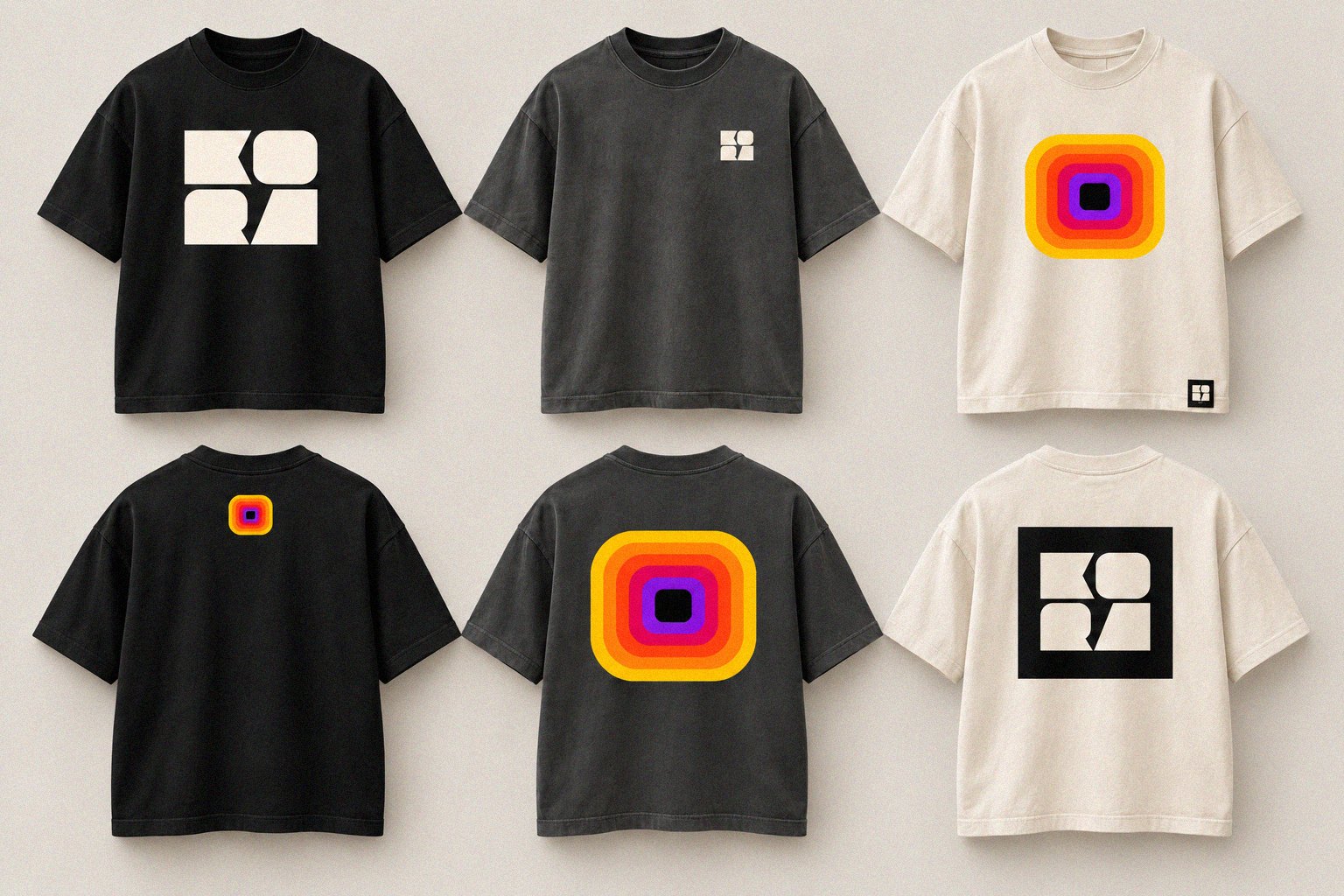
Press merchandise
Exclusive press merchandise.
KORA tees and caps, made for the reporters covering KORA. Choose the one you would like, tell us your size and where to send it, and we will mail it to you.
Tees
Black with the KORA wordmark on the front, washed black with the mandala on the back, or cream with the mandala on the front. Sizes S, M, L and XL.
Caps
Black with the wordmark, black with the mandala, or cream.
How to get one
Email pr@kora.inc with your choice, your size and a postal address.